
11th Class Biology Chapter 2 Biological Molecules Short Questions Answer
| Class: | 11th Class | Subject: | Biology |
| Chapter: | Chapter 2 | Board: | All Boards |
Explore the fascinating realm of 11th Class Biology Chapter 2 Biological Molecules Short Questions Answer. This extensive guide is designed specifically for students venturing into the intricate world of cellular structures and functions. Uncover a carefully selected compilation of concise questions that delve into the depths of biological molecules, shedding light on fundamental concepts crucial for comprehending life processes. Whether you’re studying for exams or aiming to strengthen your understanding, these succinct answers offer clarity and valuable insights. Enhance your knowledge of the molecular basis of life with this indispensable resource, deepening your understanding of the complexities of biology.
11th Class Biology Chapter 2 Biological Molecules Short Questions Answer
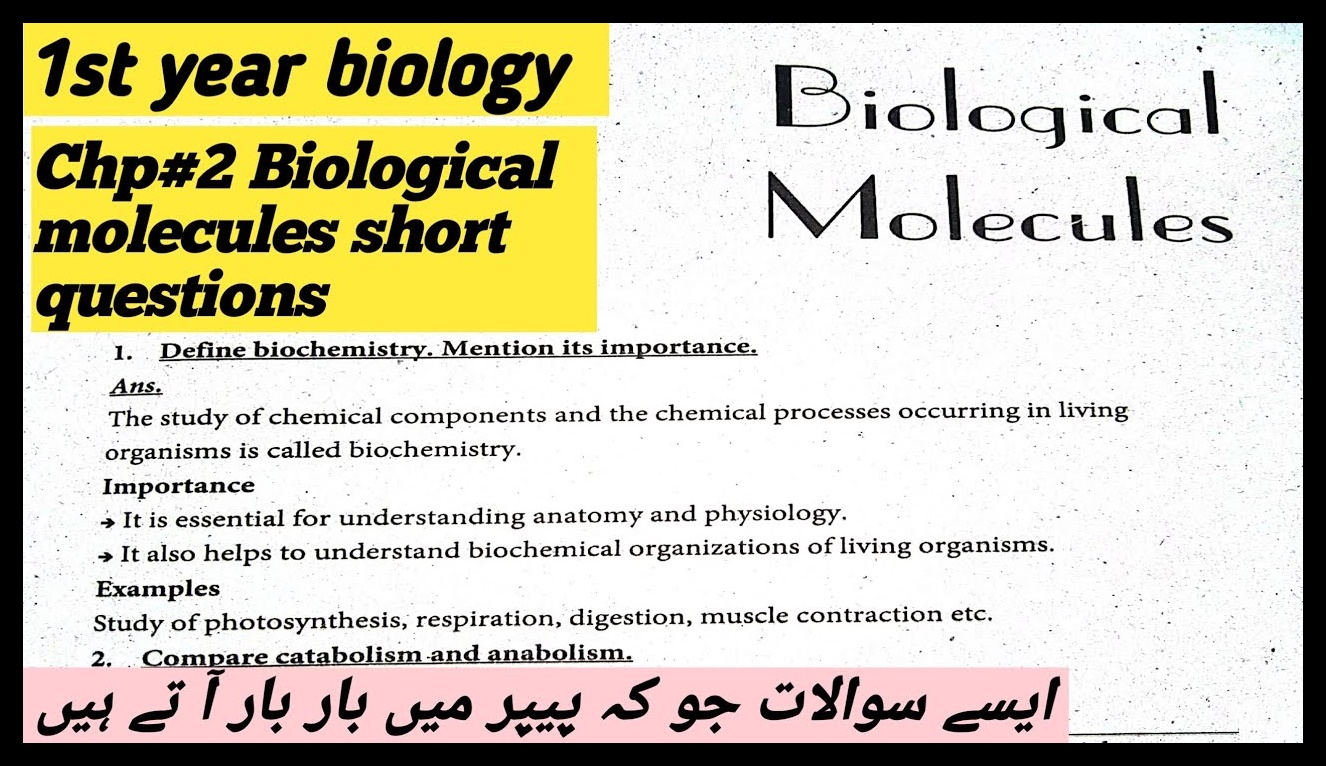 We are providing all Students from 5th class to master level all exams preparation in free of cost. Now we have another milestone achieved, providing all School level students to the point and exam oriented preparation question answers for all science and arts students.
After Online tests for all subjects now it’s time to prepare the next level for Punjab board students to prepare their short question section here. We have a complete collection of all classes subject wise and chapter wise thousands questions with the right answer for easy understanding.
Here we are providing complete chapter wise Biology questions and Answers for the 11th class students. All the visitors can prepare for their 11th class examination by attempting below given question answers.
In this List we have included all Punjab boards and both Arts and Science students. These Boards students can prepare their exam easily with these short question answer section
- Lahore Board 11th class Biology Chapter 2 Biological Molecules short questions Answer
- Rawalpindi Board 11th class Biology Chapter 2 Biological Molecules short questions Answer
- Gujranwala Board 11th class Biology Chapter 2 Biological Molecules short questions Answer
- Multan Board 11th class Biology Chapter 2 Biological Molecules short questions Answer
- Sargodha Board 11th class Biology Chapter 2 Biological Molecules short questions Answer
- Faisalabad Board 11th class Biology Chapter 2 Biological Molecules short questions Answer
- Sahiwal Board 11th class Biology Chapter 2 Biological Molecules short questions Answer
- DG Khan Board 11th class Biology Chapter 2 Biological Molecules short questions Answer
- Bahawalpur Board 11th class Biology Chapter 2 Biological Molecules short questions Answer
All above mention Punjab Boards students prepare their annual and classes test from these online test and Short question answer series. In coming days we have many other plans to provide all kinds of other preparation on our Gotest website.
How to Prepare Punjab Board Classes Short Question Answer at Gotest?
- Just Open the desired Class and subject which you want to prepare.
- You have Green bars which are Questions of that subject Chapter. Just click on Bar, it slides down and you can get the right answer to those questions.
- You can also Rate those question Answers with Helpful or not to make it more accurate. We will review all answers very carefully and also update time to time.
Now you can start your preparation here below
1.Difine biochemistry?
2.Differentiate between Anabolic and catabolic reactions?
3.What are Covalent bonds?
4.What is primary structure of Protein?
5.What is Secondary strycture of protein?
6.What is Tertiary structure of protein?
7.What is Quaternary strcture of protein?
8.Define Specific heat capacity?
9.Why these scientists are famous for:
10.What are the most important organic compounds in living organisms?
11.What is metabolism?
12.What is the basic element of organic compounds?
13.What carbon occupies the central position in the skeleton of life?
14.What is meduim of life?
`15.What is the percentage of water in human tissues?
16.Why water is an excellent solvent for polar substances?
17.Nonpolar organic molecules such as fats are insoluble in water.What is the advantage of this fact?
18.What is heat of vaporization?
19.What is the advantage of heat of vaporization?
20.What is the concentration of each of H+ and OH ions in pure water at 25ᵒC?
21.How water protects as an effective lubricant?
22.What is the general formula of carbohydrates?
23.Hoe carbohydrates are chemically defined?
24.What are the major clases or groups of carbohydrates?
25.Differentiate between glycosidic and peptide bonds?
26.What are monosaccharides found in nature?
27.What trioses are intermediates in respiration and photosynthesis?
28.What are tetroses?
29.What are most common monosaccharides?
30.What is the most important hexose from the biological point of view?
31.Differentiate between aldo-sugars and keto sugars?
32.What does happen to monosaccharides when in solution?
33.Where glucose is present in free state?
34.What is normally the concentration of gluccse in our blood?
35.Where is glucose found in combined form?.Where is it naturally produced?
36.Why the process of glucose synthesis by green plants is called photosynthesis?
37.How much solar energy s used in the synthesis of 10g glucose and in which form it is stored?
38.What do you know about the taste of carbohydrates?
39.What do you know about the solubility of carbohydrates?
40.What are physiologically important disaccharides?
41.What is sucrose?
42.What is the effect of hydrolysis on oligosaccharides?
43.What are some biologically important polysaccharides?
44.Where starch is found?
45.What does happen to starch cellulose and glycogen on complete hydrolysis?
46.How many types of starch are there?
47.Differentiate between amylase and amylopectin starches?
48.What colour are given by starch glycogen and cellulose with iodine?
49.why glycogen is called animal starch?
50.Which is the most abundant carbohydrate in nature.Where is it found in pure form?
Define amino acid?
These are small building block molecules that make up protein.
Define triglycerides?
It is a lipid compound formed from one glycerol molecule and three fatty acid molecules.
Define oligosaccharides?
It is carbohydrate molecule which yields from 2 to 10 monosaccharide molecules on hydrolysis.
Define nucleotides?
It is the building block of nucleic acid made up of a nitrogen containing base, a five carbon sugar and phosphate group.
Define secondary proteins?
Spirally coiled polypeptide chain of amino acids is called secondary proteins.
Define terpenoids?
Larger lipids compounds which are made up of simple repeating is oprenoid units are called terpenoids.
Name the carbohydrates suitable as food for man?
Glucose, fructose and galactose.
What is the percentage of water in brain cells of man?
Brain cells of man contains 85 percent water.
What is the function of mRNA?
The messenger RNA takes the genetic message from the nucleus to the ribosomes in the cytoplasm to form a particular protein.
What is meant by saturated acyglycerol?
They do not contain any double bond between carbon atom and they are solid at ordinary temperature mostly found in animals.
What is dextrin?
The oligosaccharides which contain 3 to 10 monosaccharide are commonly known as dextrin.
Name the four main types of biological molecules?
(1) carbohydrates (2) Lipids (3) Protein (4) Nucleic acid
What are biochemical?
The chemical compounds of living organisms are called biochemical and these are mainly composed of six elements carbon, hydrogen, oxygen, nitrogen, phosphorus and sulphur these substances form the 98% of the biochemical.
Define buffer?
It is a substance that binds hydrogen ion when concentration of H⁺ are higher and releases hydrogen ions when concentration of H⁺ are low.
How many structures of protein are found?
There are four basic structures of protein are found i-e primary, secondary, tertiary and quaternary.
What is condensation?
The joining of two monomers is called condensation.
What is meant by organic molecules?
Molecules which contains carbon as basic element and bounded hydrogen covalently are known as organic molecules.
What is hydrolysis?
The process in which macromolecules are broken down into smaller subunits by the addition of water is known as hydrolysis.
Water is excellent solvent for polar substances. Justify this statement.
Due to its polarity, water is an excellent solvent for polar substances. Ionic substances when dissolves in water, dissociate into positive and negative ions. Non-ionic substances having charged groups in their molecules are dispersed in water. Almost all the reactions in cell occur in aqueous media.
What is the function of non-polar substances?
Non-polar organic molecules such as fats, are insoluble in water and help to maintain membranes which make compartments in the cell.
How to Write Perfect Short Answers?
In Board Exams, the examiner looks for specific keywords and presentation. Here is how to attempt Chapter 2 questions:
- Ideal Length: Write 3 to 5 lines for each short question. Too short gets fewer marks, too long wastes time.
- Highlighting: Use a Blue Marker to highlight key dates, names, or scientific terms in your answer.
- Diagrams: In Biology, even if not asked, draw a small rough diagram for 2 marks.
More Related Resources
Can't find what you're looking for? Search below:

There is no question about RNA.why
There is no question about RNA
Very well pleasure this website awesome